 intell
When AI was introduced to the public through chatbots in 2023, it didn’t take long for developers to come up with specialized AI tools for all sorts of applications. You can find AI tools for content creation, like Murf for text-to-speech conversion and Suno for custom music generation, but there are also productivity-boosting AI solutions, such as Slidesgo, which builds presentations around your specific inputs, and Teal, which puts together the perfect resume. If you need a hand with managing your personal finances, AI apps like Rocket Money can set up a budget for you and Oportun can automatically calculate an affordable savings amount based on your data.
Beyond personal and professional use, AI has started dominating the education sector, too. It has slowly but surely turned into one of the top platforms students go to when they need extra help, but for those with limited resources, these AI assistants can be pretty expensive. Fortunately, there are some free AI tools for students you can find online.
For writing academic papers: Writefull X
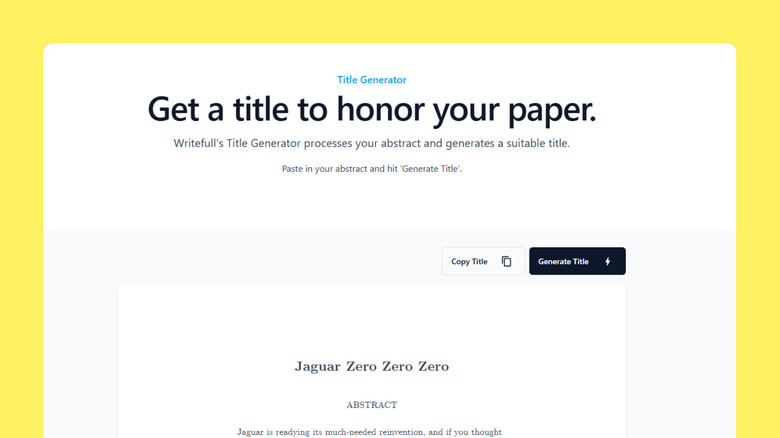
Since becoming mainstream, AI has been helping students write their essays. Writefull is one of the handy tools they’ve been using, having been specifically developed with input from PhDs in AI and Linguistics to make academic writing easier. Writefull comes with several nifty features, including a Title Generator, Abstract Generator, Paraphraser, Academizer, and GPT Detector. The Title Generator uses your research abstract to create a relevant title for your paper. Meanwhile, the Abstract Generator uses your entire paper to form the abstract. The Paraphraser, as its name suggests, paraphrases your sentence or paragraph with three levels of revisions, from Low (minor tweaks) to High (major changes made). On the other hand, the Academizer converts your casual sentences and paragraphs to have a more academic tone. Finally, the GPT Detector analyzes your copy for the presence of GPT-3, GPT-4, or ChatGPT and provides you with a probability score.
Another feature you’ll appreciate about Writefull is its accessibility. You can use it not only in your browser but also in Word via a free add-in and Overleaf via a free Chrome extension. These versions come complete with extra features, such as a chatbot that can answer questions about the text and context options that can change the style of your writing. Do note that the Title Generator and Word and Overleaf versions are free to use, while the Abstract Generator, Paraphraser, Academizer, and GPT Detector have a set usage limit per day.
For finding research papers: Consensus
Probably the hardest and most time-consuming task you’ll undertake when doing research is finding the appropriate papers for your resources and then reading through these articles to extract the information you need. This can easily take hours, if not days. This is where Consensus can help you.
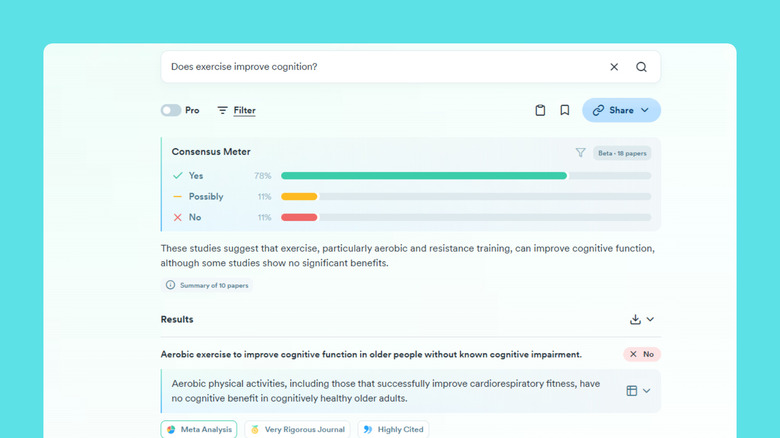
Consensus is an academic research engine. It essentially works like Google Scholar, where you input your query on the search bar, and it gives you a list of relevant research papers about that topic. However, on top of those papers, Consensus also acts like an AI chatbot and provides you with an easy-to-read analysis based on the top search results. For instance, if your query is “Can mindfulness help with sleep?” Consensus will show you a percentage rating of Yes, Possibly, or No, along with some key insights and even a conclusion derived from the papers. If the full text of the paper is available, Consensus also allows you to chat with the paper, so you don’t have to read through the entire thing.
Although you can use Consensus without creating an account, the features are very limited. The service offers both free and premium options; the free account gives you unlimited searches with research quality indicators, while features like Pro Analyses, Study Snapshots, and Ask Paper are limited. To use these functionalities without limits, you’d need to upgrade to the premium account.
For getting help with homework: Goodgrade
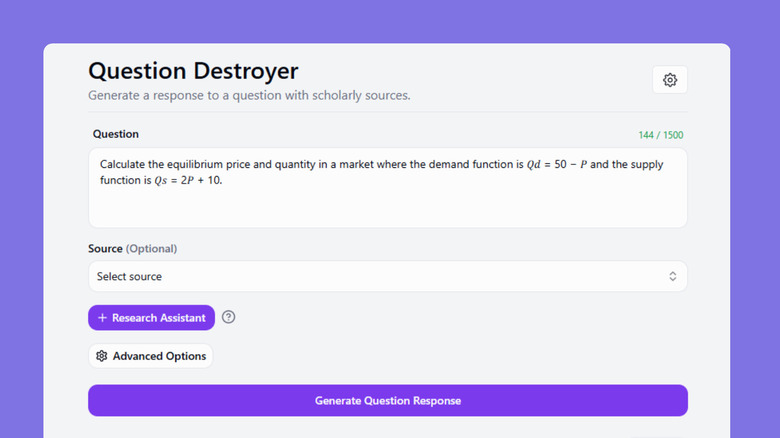
Instead of spending precious hours trying to solve an impossible homework question, use the Goodgrade AI problem solver. Aptly named the Question Destroyer, this GPT-3, GPT-4, and Claude-3-powered homework helper tool can answer any question you have, complete with step-by-step instructions and solutions, if applicable. You can use it for any subject, from basic math problems to complex science queries. Aside from providing the direct answer to your homework question, the Question Destroyer also throws in an explanation of how it came up with the answer to help you understand the lesson on a deeper level. You can even change the writing level of the Goodgrade AI problem solver to High School, University, Doctoral, or Professional, depending on the tone you’re going for. If you want the AI tool to customize its answer based on a specific source, you’re free to upload or link the source material for the tool to use.
Apart from the Question Destroyer, Goodgrade features more AI functionalities for students. There’s an essay writer that can quickly whip up an essay with a maximum of 4000 words, a humanizer that can paraphrase AI-generated text to be undetectable, and even a code generator/fixer/explainer that can do your coding assignments for you. One downside of Goodgrade, though, is that you need an account to access its features. While the account is free, it’s pretty limited, so you might need to subscribe to the Starter or Unlimited accounts.
For tutoring you on various subjects: AnswerAI
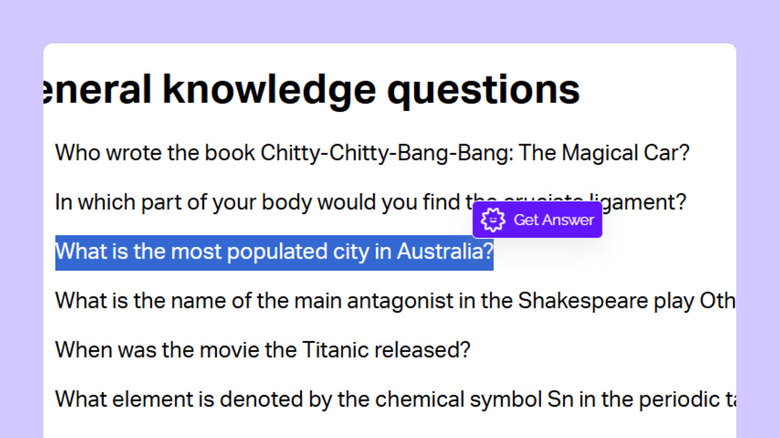
Another handy AI tool for students you can readily access from your Chrome browser is the Answer.AI Chrome extension. It’s free and easy to use: you simply highlight a question on your browser, and Answer.AI will instantly give you the answer. You can also copy and paste the question into the chat box in the side panel to talk to the AI chatbot. If your question has a graph — perhaps from geometry or trigonometry homework — Answer.AI helps with this, too, if you’re on the Premium Plan. The paid account also gets you access to the GPT-4-powered SuperAI, which can provide you with more advanced answers.
Besides answering questions, you can use Answer.AI for other tasks, such as summarizing a web page you’re on or talking to the PDF you’ll upload into the chatbox. There’s also a writing tool integrated into this Chrome extension, where you simply enter a topic you want the AI to write, choose a format (auto, essay, article, email, message, comment, or blog), the tone (auto, formal, professional, funny, casual), length (auto, short, medium, or long), and the language (currently supporting 11 languages, including Spanish, Filipino, and French). If you already have the text but want to rewrite it, just paste it into Answer.AI’s Write tool too, though you can only revise up to 2000 characters.
Are AI tools allowed in school?

While they might be convenient and time-saving, it’s important to know that AI tools may violate your school’s policy. Some educational institutions consider AI-generated text to be plagiarism and a violation of academic integrity. Using text generators like the ones featured in this article to write essays or research papers could lead to a grade penalty or even more serious consequences, so check with your institution for more guidance. The same goes with AI homework helpers, such as Goodgrade and AnswerAI. They get in the way of learning by spoon-feeding you the answer you need. They could be a handy guide to get you started, but make sure to take the time to study the material on your own.
Some schools, however, allow adding AI-generated text into academic papers as long as it’s properly cited and the students are transparent with it. It’s still best to check with your professor or review your school guidelines on the use of these AI writing tools for your assignments.
On the other hand, Consensus is generally fine to use since it isn’t necessarily a text generator. In fact, universities like Harvard, Princeton, Stanford, and University of California Berkeley all use Consensus for research purposes. You should, however, avoid copying and using Consensus’ Pro Analysis, as it’s technically AI-generated text.
Source: http://www.slashgear.com/1727813/free-ai-tools-for-students/
You may also like


On the other hand, the Academizer converts your casual sentences and paragraphs to have a more academic tone.